For a cleaner, more prosperous world, ACC mobilizes conservatives around environmental issues, fostering collaboration in the pursuit of environmental conservation.
Imagine you are standing at a shoreline, watching the tide come in and out and in again. It ebbs and flows, as all things must, until it goes out and, rather than returning, it ebbs again. It continues to recede, a perpetual retreat. In your alarm, you are suddenly reminded of what was: a vast inland sea that shaped the life and very climate around it, a landmark visible from the heavens, a home for ten million migratory birds a year, large enough to have its own weather patterns. The water is the color of rose quartz; it is the kind of place so strange and beautiful and vast that it shocks your senses and scope of what the interior of a continent can even be, of what is even possible.
It is now diminished.

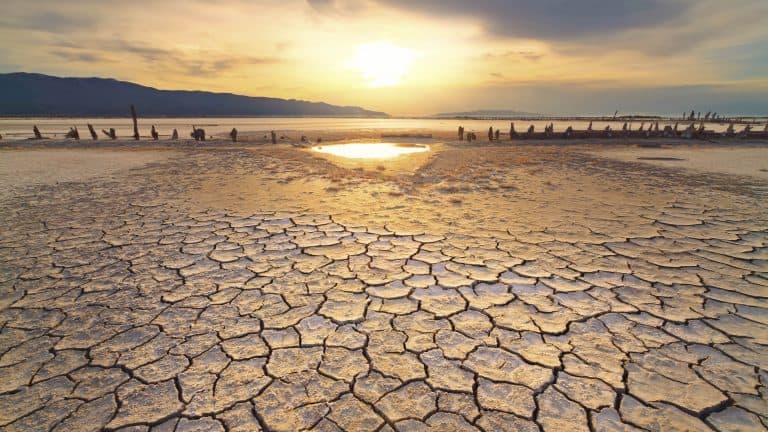
If we are measuring by its historical average, the Great Salt Lake has lost roughly half its original surface area. If we instead count from its modern high-water mark in the late 1980s to its recorded low in 2022, it has lost more than two-thirds of its surface area. Where water once lapped against the banks is now miles of desolate, exposed lake bed, cracked and alkaline white. When the winds blow across those flats, it whips up selenium and arsenic, carrying it east into the lungs of the people of the Wasatch Front and Salt Lake City. Health is not the only thing harmed, however, the brine shrimp harvest that supplies the aquaculture industry shrinks as the salinity shifts. The impact is not confined to the local. The impact on the aquaculture industry has global implications. Beyond the lost health and wealth, however, is the impact on animals as a consequence of their instinct, their marrow-deep blood memory. The pelicans and the phalaropes and the eared grebes all still come to the lake, only to find shrinking resources because they have not received the news that the habitat for which they search is no longer entirely there. Yes, a lake is not merely the water that it contains. The lake is the entire system that it holds, a symbiotic relationship between water and air and land and every creature that has oriented its little life around the assumption that the lake will exist. Yet, for all the dire warnings and grim outlook, the Great Salt Lake is still there.
So what can we do to save it?

The answer is neither mysterious nor is it politically impossible. It merely lies in allocation. Roughly 60% of all water that would otherwise flow into the Great Salt Lake is diverted mainly for agricultural use, with the majority of that water going to alfalfa and hay. This is the consequence of a system of water rights that suited the region, as Utah’s population was small and the economy was still largely driven by agriculture in the early 20th century. Farmers today use water that was allocated in a different era for crops that made sense under different conditions and a different economy. At this point, the solution is to just make conservation more attractive than consumption.
That’s the approach ACC and our friends brought to the table at a recent roundtable event with Utah Governor Spencer Cox, Great Salt Lake Commissioner Brian Steed, and other federal leaders. We discussed innovative market-based solutions, including voluntary water markets that compensate farmers for conserving rather than consuming, agricultural efficiency improvements that reduce how much water irrigated fields even require, infrastructure upgrades that cut losses in the delivery system, and cloud seeding programs that add water to the lake directly.
The political capital is there; the roundtable comes off the heels of President Trump’s request to Congress for one billion dollars in investment for the Great Salt Lake, indicating this issue has national attention and the potential for bipartisan support. At the state level, Governor Cox’s GSL 20234 initiative aims to restore the lake before Salt Lake City hosts the Winter Olympics, which adds a tangible deadline. It’s not every day that a conservation goal arrives with the perfect mixture of known solutions, political willpower, and a realistic timeline.

At the roundtable event, ACC President Chris Barnard stated, “Restoring the Great Salt Lake will set a benchmark for future water conservation projects,” and “benchmark” seems like the profoundly right word here. The American West contains many over-allocated watersheds, shrinking lakes, and communities downstream of a century of unsustainable water management. Consider the Colorado River, the Salton Sea, or even Owens Lake, which dried entirely in 1920 and has caused a major dust problem for the last century. No country or state has ever restored a declining saline lake in history. What we accomplish with the Great Salt Lake over the next decade will be watched by every water manager and agricultural community from the Rockies to the Pacific.
You imagined a lake ever receding at the start of this article. Now imagine a lake brought back from the brink by voluntary markets and smarter infrastructure. Imagine that model travelling and becoming the norm. What could be?
The pelicans will return and find what they came for, the brine shrimp will thrive, and the people of the Wasatch Front will breathe easier as the rose quartz water pushes back and reclaims the white cracked flats.

Ryan Anderson is the Stakeholder Communications Manager at the American Conservation Coalition.